
18. Offices And Workshops for El Noticiero Universal. 1963-1965
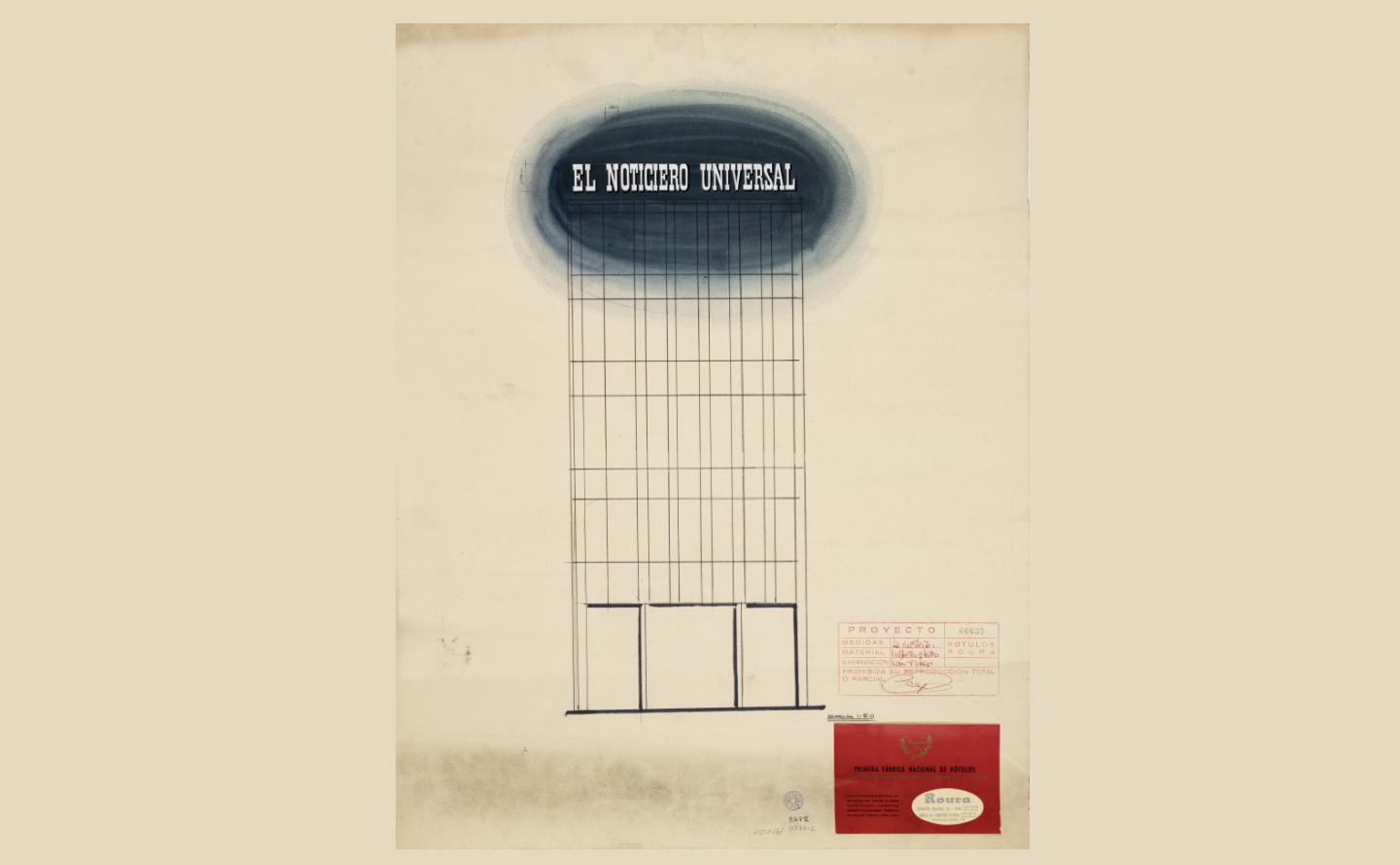 Disseny per al rètol de l'edifici del "Noticiero Universal". Josep M Sostres Maluquer, 1964. Fons Sostres Maluquer, Arxiu Històric del COAC
Architect: Josep Maria Sostres
Location: Roger de Llúria, 35
Sostres’ designs lend themselves to a precise typological grouping: houses in the mountains, hotels, houses along the Mediterranean coast. For its part, the office and workshop building for El Noticiero Universal on carrer Roger de Llúria constitutes a unique experience in Sostres’s work, both for the programme and for the construction system and because of its location in the centre of Barcelona.
The project is an expansion of the newspaper’s old premises through the annexation of a new building, built on the adjoining lot, with a façade measuring some 8 metres. The small size of the intervention and the apparent neutrality of its configuration make El Noticiero a less than spectacular architecture; there is nothing flashy about it. A first glance may provide the image of a silent building, passively integrated into the surrounding landscape.
Its public significance, on the other hand, has not coincided with those characteristics. The year it was finished, 1965, it won the FAD prize for architecture, awarded annually by the association Fostering Arts and Design to the most significant work carried out in Barcelona. Subsequently, the El Noticiero building came to be considered an important episode in modern architecture in Barcelona, and although it would not be accurate to say that it created a school, it became a precise reference for many.
Finally, another noteworthy aspect refers to its construction. A grid of guiderails is installed above the floor structures so that the loads from the workshop machinery remain evenly distributed. Plastic pieces are installed at the support points to dampen the intense vibrations. The façades are independent from the rest of the structure: the rear façade is a curtain wall; the one facing the street is made of brick, with the bricks installed vertically and adequately reinforced. Where appropriate, the opaque elements are replaced by openings. The cladding, in plaques of stone from Figueres, is attached by means of clamps. The result is pertinent in technical terms, but it also demonstrates the high degree of conceptuality and rigor with which Sostres addresses the resolution of details.
In recent times, the importance of this building has not waned. On the contrary, in line with recent orientations, the compositional rigor, the degree of formal abstraction and the clear, taught use of the plane that characterize it have only incremented its relevance and interest.
One wonders why the building is so fascinating, why it exhibits such frank ease, such a simple and obvious tone. No doubt, there are any number of answers, and it is impossible to entirely decipher the charm produced by looking at this severe, exact, profoundly classical architecture. For us, El Noticiero Universal is a work that is hard to understand outside the context of Barcelona’s Eixample. The Eixample is a complex reality, made up of various components and historical layers. It is also the story of a frustration: of the original project Cerdà devised. Sostres’s building seems to be tied not so much to the built Eixample as to the other analogous idea of what Cerdà’s grid could have become. In this sense, El Noticiero invents a non-existent Barcelona but whose image can be reconstructed through designs, descriptions, drawings, fragments of architecture.
The myth of Cerdà’s possible Barcelona – forged around the dispersed catalogue of formal, constructive and typological elements that constitutes the architecture of industrial Barcelona and the master builders in the first phase of the Eixample – is somehow present in this work by Sostres. El Noticiero hides a subtle reflection on the themes of this architecture: the anti-rhetorical tone, the uniform and repeatable character, the constructive investigation, the interest in modulation.
It is no coincidence that El Noticiero butts up against the buildings on either side of it. They both respond to the characteristic model used by master builders in Barcelona, which has been said to constitute “the perfect expression of the spirit of the Cerdà Plan” in its architectural aspect.
Very close to El Noticiero is one of the most representative examples of this type of architecture, the building at the intersection of Roger de Llúria and Consell de Cent, attributed to Cerdà himself. As we can see, there are a wealth of cultural references and associations that nourish this small work and explain its poetic nature.
2C Construcción de la ciudad, no. 4, August 1975, p. 45.